Delta-8 vs. Delta-9 THC: What You Need to Know
Delta-8 THC is everywhere, but how does it compare to traditional Delta-9? Here's the science, the legality, and what to expect from each.
By Hightree Team for The Canopy
March 21, 2026 · 7 min read
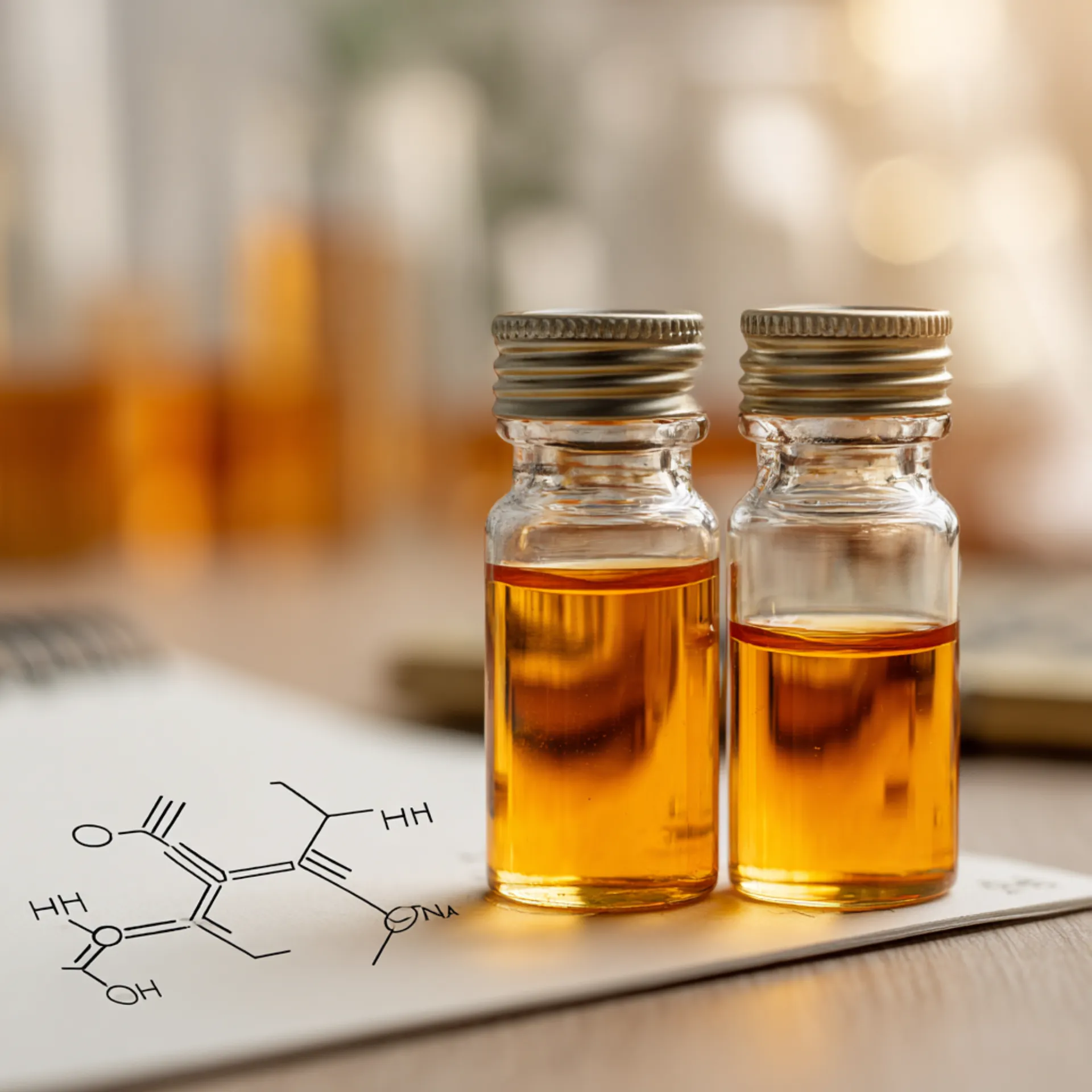
Laboratory glass vials with amber liquid in a scientific setting
Delta-8 THC exploded onto the cannabis market in 2020 and hasn't slowed down since. Sold in gas stations, smoke shops, and online retailers across the country, it's marketed as "legal weed" or "diet THC" — a milder, less anxiety-inducing alternative to traditional cannabis.
But what actually is Delta-8? How does it compare to the Delta-9 THC in regular cannabis? And is it really legal?
The answers are more complicated — and more important — than most consumers realize.
The Chemistry
Delta-8 and Delta-9 THC are isomers — molecules with the same chemical formula (C21H30O2) but a slightly different atomic arrangement. Specifically, they differ in the location of a double bond on their carbon chain:
- Delta-9 THC: Double bond on the 9th carbon
- Delta-8 THC: Double bond on the 8th carbon
This tiny structural difference changes how each molecule interacts with your endocannabinoid system. Both bind to CB1 receptors in the brain (which is why both produce psychoactive effects), but Delta-8 binds with less affinity — roughly 50-75% of Delta-9's binding strength, depending on the study.
The result: Delta-8 gets you high, but it's a different kind of high.
How They Feel
Delta-9 THC
The classic cannabis high. Effects include:
- Strong euphoria and mood elevation
- Altered perception (time, sound, visuals)
- Deep relaxation or energetic stimulation (strain-dependent)
- Increased appetite
- Potential for anxiety or paranoia at higher doses
- Duration: 2-4 hours (smoked), 4-8 hours (edibles)
Delta-8 THC
Often described as "Delta-9's younger sibling." Effects include:
- Mild to moderate euphoria
- Relaxation without heavy sedation
- Clearer headspace — less "foggy" than Delta-9
- Reduced anxiety compared to Delta-9 (at equivalent doses)
- Mild appetite increase
- Fewer reports of paranoia
- Duration: Similar to Delta-9
The most common description from users: "functional high." Delta-8 tends to produce relaxation and mood elevation without the intense psychoactivity that can make Delta-9 overwhelming for some people.
However, dose matters. At high enough doses, Delta-8 can produce effects that are very similar to Delta-9, including anxiety. The "milder" reputation is partly a dose effect — many Delta-8 products are sold at lower effective doses.
How Delta-8 Is Made
This is where things get interesting — and controversial.
Delta-8 occurs naturally in cannabis, but in tiny amounts (less than 0.1% of the plant's cannabinoid content). You can't grow a Delta-8-rich strain the way you can grow a high-THC or high-CBD strain.
Instead, commercially available Delta-8 is synthesized from CBD. The process:
- Start with CBD extracted from legal hemp
- Dissolve the CBD in an acid catalyst (often sulfuric acid or p-toluenesulfonic acid)
- The acid rearranges CBD's molecular structure into Delta-8 THC (a process called isomerization)
- Purify the resulting product to remove byproducts and reagents
This synthesis process is the source of most concerns about Delta-8:
- Byproducts: The conversion can produce unknown compounds if not done correctly. Some studies have found unidentified cannabinoids in Delta-8 products that don't exist naturally in cannabis.
- Residual chemicals: Improper purification can leave acid residues, heavy metals from cheap equipment, or solvent contamination.
- Inconsistent quality: Because there's no federal manufacturing standard, quality varies enormously between producers.
This doesn't mean all Delta-8 products are dangerous. Well-made Delta-8 from reputable manufacturers with thorough lab testing can be a perfectly safe product. But the lack of regulation means the consumer bears the risk of verification.
Legality: The Gray Area
The 2018 Farm Bill Loophole
The 2018 Farm Bill legalized hemp and "all derivatives, extracts, and cannabinoids" of hemp, as long as the final product contains less than 0.3% Delta-9 THC by dry weight.
Delta-8 manufacturers argue that since their products are derived from legal hemp CBD and contain less than 0.3% Delta-9 THC, they're federally legal.
The DEA's Position
The DEA has stated that "synthetically derived" cannabinoids remain Schedule I controlled substances. Since Delta-8 is converted from CBD through a chemical process, the DEA considers it synthetically derived — and therefore illegal.
State Laws
As of 2026, the state-by-state landscape is a patchwork:
- Explicitly banned: At least 20 states have banned Delta-8 (including Colorado, New York, and Oregon — states with legal recreational cannabis)
- Explicitly legal: A handful of states have explicitly legalized and regulated Delta-8
- Unregulated: Many states haven't addressed Delta-8 at all, creating a true gray area
The legal situation is still evolving. Check your state's current laws before purchasing.
Safety Concerns
The Testing Problem
Legal Delta-9 cannabis products go through rigorous state-mandated testing: potency verification, pesticide screening, heavy metals, residual solvents, microbial contamination.
Most Delta-8 products have no such requirements. Some manufacturers voluntarily test their products, but:
- Testing is often only for potency, not contaminants
- Some products have tested positive for residual acids, heavy metals, and unknown compounds
- "Lab tested" on a label doesn't mean "comprehensively tested for safety"
What to Look For
If you choose to use Delta-8, prioritize:
- Full panel third-party lab results (not just potency — look for solvents, metals, pesticides, and unknown cannabinoids)
- Reputable brands with transparent manufacturing processes
- Products from states with Delta-8 regulations (some states now require testing)
- Avoid gas station or convenience store products — these have the highest risk of contamination
Delta-8 vs. Delta-9: Direct Comparison
| Factor | Delta-9 THC | Delta-8 THC |
|---|---|---|
| Potency | Full strength | ~50-75% of Delta-9 |
| Anxiety risk | Higher at high doses | Lower (but not zero) |
| Clarity | Can be foggy | Typically clearer |
| Source | Natural (cannabis plant) | Synthesized from CBD |
| Regulation | Heavily regulated in legal states | Mostly unregulated |
| Testing | Mandatory in legal markets | Voluntary (mostly) |
| Legality | State-by-state (recreational/medical) | Federal gray area |
| Product quality | Consistent (in legal markets) | Highly variable |
| Drug testing | Will trigger positive | Will likely trigger positive |
| Research | Extensive | Limited |
Who Might Prefer Delta-8
Delta-8 can be a reasonable choice if you:
- Find Delta-9 too intense or anxiety-inducing
- Live in a state without legal recreational cannabis (and Delta-8 is legal)
- Want milder psychoactive effects for daytime use
- Are experienced with cannabis and looking for variety
Who Should Stick with Delta-9
Delta-9 from regulated dispensaries is the better choice if you:
- Live in a state with legal recreational or medical cannabis
- Want guaranteed product quality and safety testing
- Need stronger therapeutic effects
- Prefer products with decades of research behind them
- Value transparent, regulated manufacturing
The Bottom Line
Delta-8 THC fills a real gap in the market — it offers a milder psychoactive experience that some consumers genuinely prefer. But its unregulated status means product quality and safety are not guaranteed.
If you live in a state with legal cannabis, regulated Delta-9 products from licensed dispensaries or trusted marketplaces are objectively the safer choice. The testing, oversight, and quality control simply aren't comparable.
If you do choose Delta-8, treat product selection like a safety decision — because it is. Buy from transparent brands, demand full lab panels, and avoid products without clear provenance. What you put in your body matters, regardless of which carbon atom has the double bond.
The Canopy Daily — April 29, 2026
Texas hemp court fight, Missouri's hemp ban, North Carolina opens medical door, Virginia bill in limbo, and Indiana's surprise pivot.
The Canopy Daily — April 26, 2026
State-by-state rescheduling fallout, Trump urges Congress on hemp, IRS tax guidance coming, and 70% of Americans support legalization.
Ohio Judge Blocks Hemp Beverage Ban: 'THC Is THC No Matter Where It Comes From'
Ohio court halts state ban on hemp-derived THC beverages, with judge rejecting the distinction between hemp and marijuana THC that underpins state regulation.